Progressive overload is a simple strength training system where you gradually increase the demand on your muscles over time, by adding weight, reps or sets, or by improving your form, so your body keeps adapting and getting stronger instead of stalling at the same numbers week after week.
If you've been lifting for a while but your numbers haven't moved, you're not broken. You're normal. Plenty of people hit the same weights, the same way, for months. Then they wonder why they never actually get stronger.
Your body is efficient. Give it the same challenge, and it gives you the same result. No reason to adapt. The missing piece is a clear, repeatable system for strength training progression. At The Barbell Club on Swiss Avenue in Old East Dallas, we use progressive overload to turn random workouts into planned strength gains for busy people who don't have time to guess.
What Is Progressive Overload?
The Short Version
Progressive overload means you slowly make your training harder over time in a controlled way. You nudge your body just past what it's used to, then let it recover and adapt. Repeat that enough times, and "heavy" becomes your new normal. That's how to get stronger, safely and steadily.
Why Most People Plateau
Most lifters either do the exact same workout forever or randomly change everything every week. Neither gives your body a clear message. No pattern, no progression, no reason for your muscles and nervous system to level up. You feel tired, but not actually stronger.
Coach's note: Feeling wrecked after a workout doesn't equal progress. Measurable improvement over time does.
The 4 Mechanisms of Progressive Overload (Weight, Reps, Volume, Form Quality)
1. Weight: Adding Load to the Bar
This is the classic version: you add a small amount of weight when you can handle your current load with solid form. Say your squat is 135 lb for 3 sets of 5. Next week, you go to 140 lb. Tiny jumps, big long-term payoff. This is the backbone of strength training progression.
2. Reps: Doing More Work with the Same Weight
If the weight can't go up yet, the reps can. You might stay at 135 lb but move from 3 sets of 5 to 3 sets of 6. Your muscles still see more total work, so they still have to adapt. This is especially useful when life stress or sleep is rough but you still want progress.
3. Volume: More Sets Over the Week
Volume is the total amount of work you do: sets x reps x weight. You can overload by adding an extra set, or by spreading more quality work across the week. For busy people, this is a way to match training stress to your schedule without wrecking you for work the next day.
4. Form Quality: Making Each Rep "Heavier"
Better technique actually makes the same weight more challenging for the right muscles. Slower control, full range of motion, tight bracing: your body has to work harder, even if the plates don't change. This is huge for lifting safely and building strength that carries over to real life.
Why Progressive Overload Works: The Science (Without the Jargon)
Your body hates wasted effort. When you keep throwing the same challenge at it, it figures out how to handle that load with less stress and stops there. But when you gently bump things up, with more weight, more reps, a cleaner rep or an extra set, it reads that as a signal: "We need to be stronger next time." That's progressive overload in action.
Behind the scenes, your nervous system learns to recruit more muscle fibers, more efficiently, and your muscles themselves get bigger and more capable. You don't need to know the science terms to benefit from it. You just need a simple plan that makes training slightly harder over time, lets you recover, and then repeats. That's how heavy weight starts to feel "normal," and that's how real strength is built.
Key takeaway: No new challenge, no new adaptation. Small, consistent increases beat random brutal workouts.
Here's the whole rule in plain words. Say you have 135 lb on the bar and the target is 5 reps per set:
- Hit all 5 reps on every set with good form? Add 5 lb next time.
- Came up short? Keep the same weight and repeat it until you hit 5 clean reps.
That's all we're doing in the gym: if you hit the target with good form, we nudge the challenge up. If not, we repeat, refine and earn the next bump.
How We Apply Progressive Overload at The Barbell Club
1. Structured Programs, Not Random Workouts
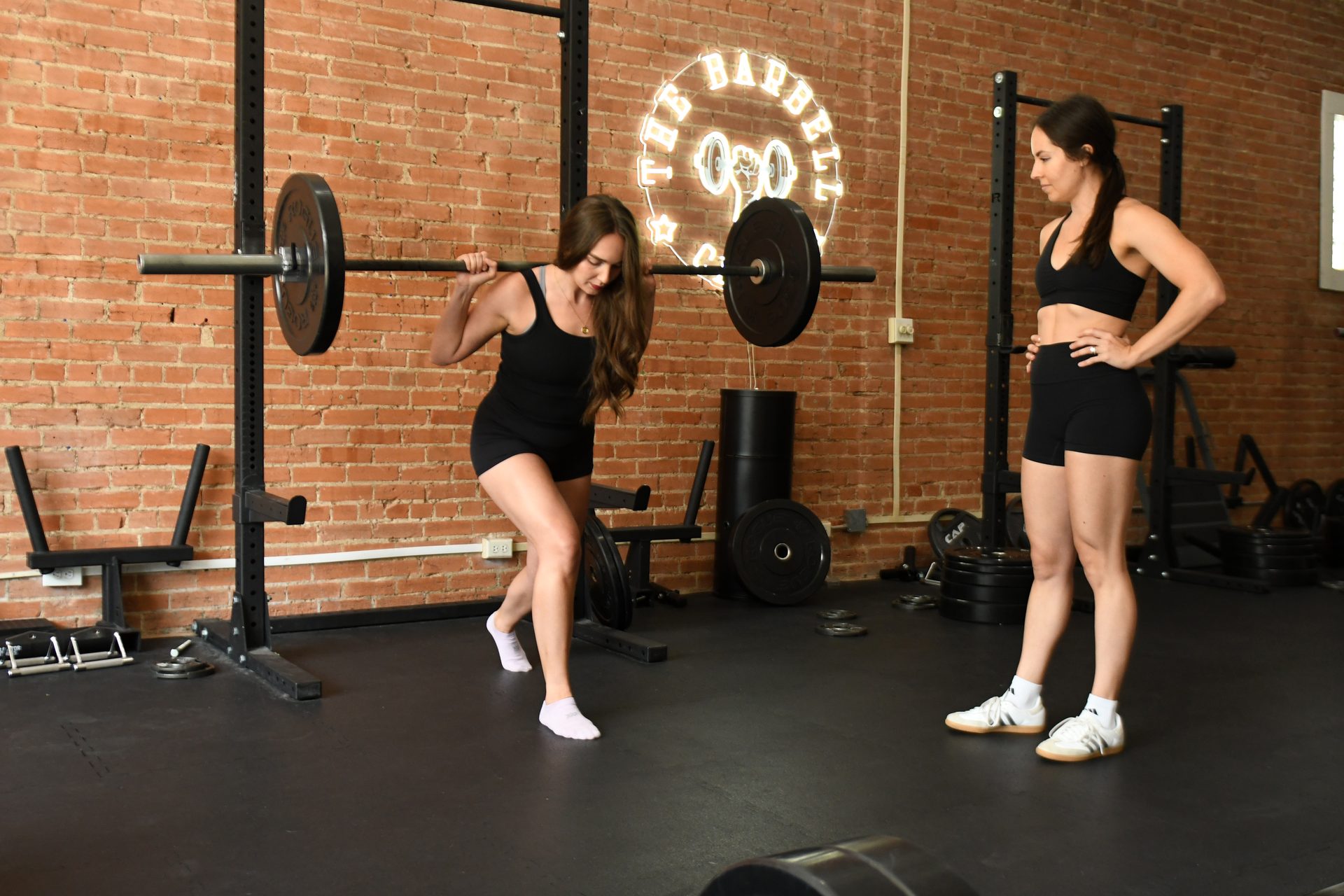
Our classes are built on progressive overload, with workouts based on sets and reps rather than racing against a timer. The main lifts come back week after week so they can actually progress. No guessing, no "what should I do today?" Just a clear path to getting stronger in a way that fits your life.
2. Tracking System from Day One
You can't overload what you don't track. Write down every main lift: the weight, the sets and the reps. A notebook or a notes app is plenty. When you know what you did last time, it's easy to decide whether to add weight, add reps or sets, or spend the day on cleaner form. In class, your coach uses those numbers to help you pick the right weight.
3. Small Classes Capped at 12
Our strength classes are capped at 12 people. That's on purpose. It gives us enough energy in the room to push you, but enough attention to actually coach you. We watch your sets, adjust loads, and call it when your form starts to slip.
4. Coaching That Respects Your Life Outside the Gym
You're not a full-time athlete. You're juggling work, a commute and family. Our coaches help you pick weights and modify movements based on how you're moving that day, so you keep moving forward without feeling wrecked the next morning.
When your progress is written down where you can see it, plateaus stop feeling permanent.
Common Progressive Overload Mistakes to Avoid
Ego lifting: Adding weight faster than your form can handle. Looks impressive, feels risky. We'd rather see you add 5 lb a week for months than jump 30 lb once and tweak your back.
Random programming: New workout every day, no progression, no tracking. Fun for a while, frustrating long-term. Your body needs repetition to adapt and a clear "next step" each week.
Ignoring form: Treating technique as optional. Sloppy reps might move more weight today, but they cap your strength tomorrow. Clean form is the fastest, safest way to get stronger.
Comparison Table: Progressive Overload Methods
| Method | What Changes | Example | Best For |
|---|---|---|---|
| Add Weight | Load on the bar increases | Squat 135 lb to 140 lb for 3x5 | Building maximal strength efficiently |
| Add Reps | Reps per set increase | Bench 3x5 to 3x6 at the same weight | When weight jumps feel too big or you're under-recovered |
| Add Sets (Volume) | Total sets per lift increase | Deadlift 3x5 to 4x5 at the same weight | Building work capacity and muscle while keeping load steady |
| Improve Form / Tempo | Control, range of motion, speed | Same weight, 3-second lower on each squat | Joint-friendly progress and skill building at any level |
Conclusion: Ready to Get Stronger on Purpose?
If your current plan is "do a hard workout and hope," you've already seen where that leads: plateaus, frustration and the same weights staring back at you. Progressive overload gives you a simple roadmap for how to get stronger week after week, even with a busy life in Dallas. Results vary from person to person, but the method is the same for everyone: small steps, done consistently.
At The Barbell Club on Swiss Avenue, we handle the programming and the coaching. You show up, lift, and work on moving those numbers up.
Frequently Asked Questions
Can beginners do progressive overload?
Yes. Beginners are actually great candidates. You adapt quickly, so small, smart increases tend to show up early. The key is starting with light enough weights to learn form, then letting the numbers climb gradually under a coach's eye.
How often should I increase weight?
Early on, many lifters can add a little weight every session on big lifts like squats and deadlifts. As you get stronger, that might slow to weekly or even every few weeks. Use your logged numbers and how the last session moved to decide whether to bump weight, add reps or just repeat.
What if I miss a session?
Life happens. If you miss a day, a good rule is to repeat your last successful session instead of jumping ahead. If you miss a full week, dial the weight back slightly and rebuild. You don't lose all your strength in a few days, but your body appreciates a short ramp back up.
Is progressive overload the same for men and women?
The principles are identical. Muscles and nerves adapt the same way. The differences are usually in starting loads, rate of increase and recovery needs. We coach both men and women with the same system, tuned to each person's training history and schedule.
Do I have to lift heavy to use progressive overload?
"Heavy" is relative. For some, that's a 300 lb deadlift; for others, it's a 45 lb bar moved with perfect control. Progressive overload just means "a bit harder than last time," not "max out every day." We meet you where you are and build from there.
Book a Free Strength Class
Come see progressive overload in action at 3112 Swiss Ave. It's a real one hour class with a coach helping you pick your weights, then about 10 minutes to talk about your goals and get a recommendation. No pressure.